ORCA's New Report
ORCA published a report on the impact of independent record labels. By Patrick Clifton, ORCA's Executive Director

Welcome to the Substack for the Organization for Recorded Culture and Arts, or ORCA. If you don’t know about ORCA, we’re a think tank and advocacy group founded by some of the world’s best known independent record labels. Our purpose is to increase music’s economic, social, and cultural value and to articulate how independent record labels help to do that. You can read more about ORCA at our website, orcaformusic.com. You can also follow us on instagram ( orcaformusic ) and on Linkedin. We’ll publish articles here from a number of different authors on topics of interest to our community of supporting record labels.
I was excited to start working with ORCA earlier this year. ORCA’s founders were global record labels, each with a distinct identity, who release a lot of the music that I love. In a decade where the role of record labels has been questioned, leading ORCA is a unique opportunity to help reclaim the place of independent record labels as creative and intellectual leaders within music and culture. There is no more urgent time for this leadership, as the headwinds that impact recorded music turn into a full-blown blizzard (the perspective of Darius Van Arman, co-lead of Secretly Group, one of ORCA’s founding supporters, can be found in this detailed article on Stereogum).
ORCA’s initial contribution to thought leadership in music was the creation of a report called Setting The Stage: How Music Works. Designed for those in government, regulators and other public organisations, the report is a detailed and accurate explanation of the intricate recorded music ecosystem. In many ways it signposts part of ORCA’s foundation story. In the wake of the Broken Record campaign and the political scrutiny in the UK’s parliament that followed, many of ORCA’s founders felt a sense of frustration at what appeared to be a lack of understanding of how the industry of music fits together and functions - as well as the distinct nature of their type of label and their type of “indie”.
ORCA’s second report, The Economic and Social Impact of Independent Record Labels, add an evidence base to discussions about different models for recorded music. Authored by the Center for Music Ecosystems, it puts data from nine of ORCA’s founding supporters under the microscope. You can read the full report, or download the exec summary, here. It’s the first time this type of label has has had their data collected and analysed. Compiled from 2023 data, among other metrics, the report shows that for every $1 those labels invested, $1.77 in revenue was generated, and of the $0.77 profit, 77% was paid to artists.
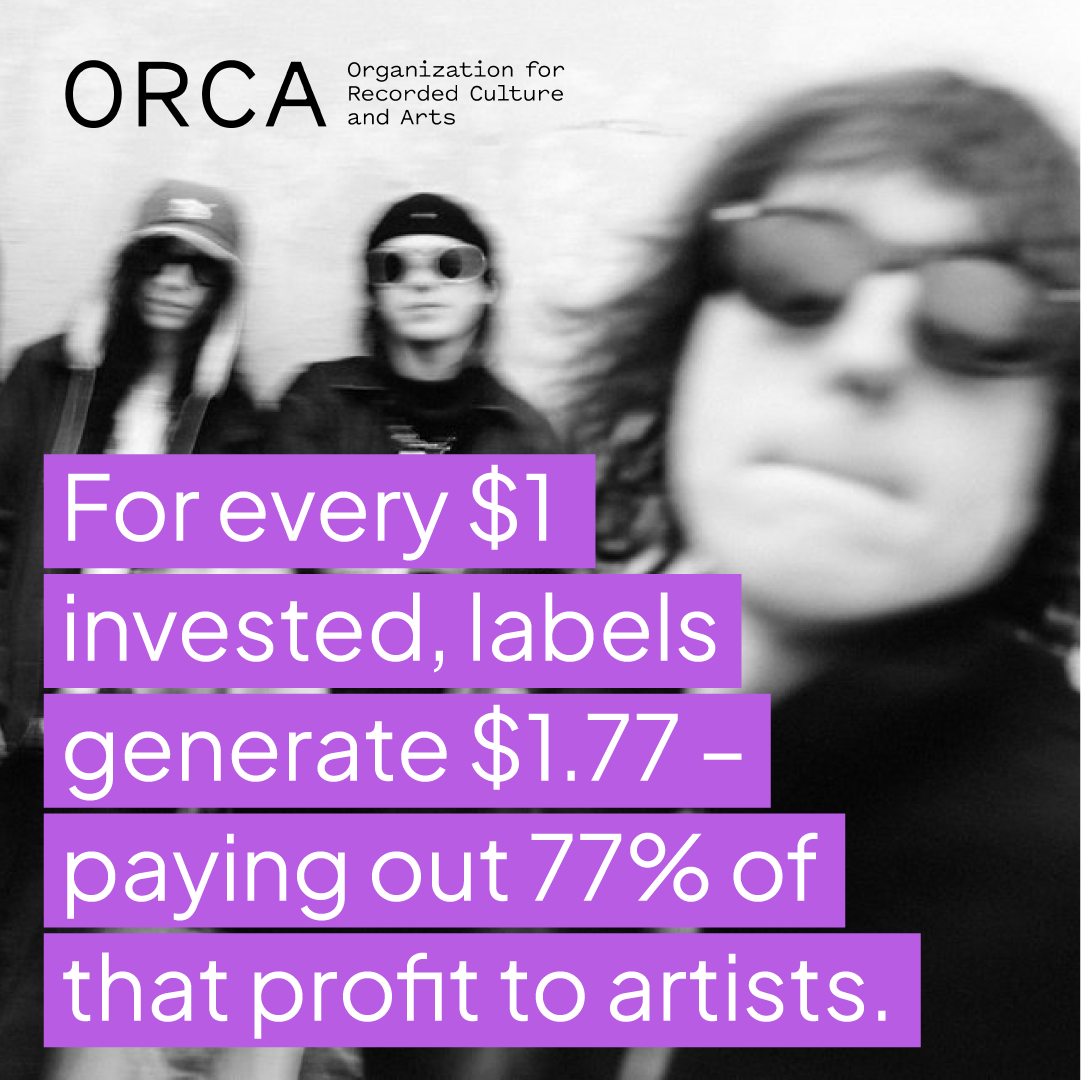
These payments will include advances, so this figure not only captures the significant risk those labels take in signing new artists that may not yield a return, but also payments that won’t be recouped until later (just as the revenue generated will be an accumulated return on investments made in prior years). The report also breaks down the investments labels make in marketing, distribution, content creation, recording and production as well as the intensity of investment in operational infrastructure and general overheads.
This investment in infrastructure is a critical differentiator. Offices resourced by long-serving employees may sound pedestrian, but is core to an implicit qualitative theme that runs through the report. The attention to detail paid to artist development: the generation of strategy, the hands-on assistance with creative output, the commitment to tenured, well-trained staff; and the focus on building long-term relationships with artists that manifest over several years and album cycles - these are the building blocks of success for the labels who participated in this research.
We hope those reading the report, be they legislators keen to develop an understanding of the music ecosystem, or managers wishing to explain the different types of music companies to artists, now have a tool to understand the distinctive nature and qualities of this type of independent record label.
As Record Of The Day put it, the report “argues with numbers that the indie model (the slow-burn, artist-first, partnership-oriented route) isn’t some flaky ideal – it’s a legit business tactic that delivers culture, and perhaps more notably, cash.”